

The Infrastructure of Trust

How local governments build lasting credibility through High Performance Communications
Let’s be real. Most people don’t trust the government.
Not Congress. Not the statehouse. And increasingly, not even their city or county government.
And if you work in local government, especially in leadership or communications, you’ve felt that in comment sections, public meetings, and even employee surveys.
But trust can be built. I’ve seen it happen.
At the City of Round Rock, Texas, where I worked for nearly 24 years, the latest citizen survey showed resident satisfaction with city communications was twice the national average and nearly three times the state average.

Source: City of Round Rock, Texas, survey conducted by ETC Institute
But strong communications alone doesn't tell the whole story.
Round Rock has earned the Leading the Way Award from ETC Institute three times — in 2021, 2023, and 2025. It's not a participation trophy. It recognizes communities that rank in the top 10 percent nationwide based on resident survey data. And the criteria have nothing to do with messaging or branding. They measure overall quality of services, customer service provided by city employees, and the value residents feel they receive for their taxes and fees.
That's the governing receipt.
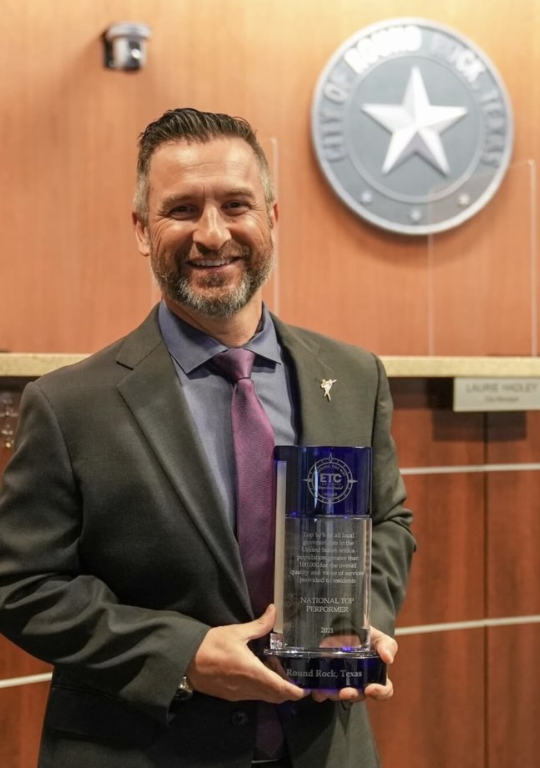
Round Rock Mayor Craig Morgan with the Leading the Way Award from ETC Institute, which recognizes communities ranking in the top 10 percent nationwide for resident satisfaction with city services, customer service, and value received for taxes and fees. Round Rock has earned the award three times — in 2021, 2023, and 2025.
High Performance Communications doesn't sit on top of mediocre governing and make it look better. It's integrated into a system that produces real outcomes, built intentionally, over time. In Round Rock, communications wasn't a separate lane. It was connected to strategic priorities, aligned with budget and council direction, and rooted in a culture that treated it as a leadership function, not a support service.
When those elements work together, residents don't just say, “They communicate well.” They say, “This city delivers.” That kind of credibility doesn't happen overnight. It’s what you get when you play the long game.
Why ‘The Long Game’ Matters
Government is the long game.
Local planners create 10-year comprehensive plans to guide future zoning decisions and manage growth. Master plans for infrastructure (roads, water, parks) take years to design, fund, and implement. Smart cities anchor their vision and mission statements decades into the future.
All of that takes effective governance.
And here’s the truth:
You can only govern as well as you can persuade.
And you can’t persuade if people don’t trust you.
Not About Marketing
This is about real connection with the residents and businesses who've chosen to call your community home. It’s about explaining decisions, owning mistakes, and showing people how your work supports their lives, day in and day out.
High-performance communication isn’t just the job of the PIO. It’s a leadership function.
If your executive team isn’t aligned on messaging, priorities, and tone, your credibility suffers, internally and externally.
What This Series Is About
The Five Elements of High-Performance Communication offers a framework for building trust, credibility, and real alignment between your organization and the community you serve.
Strategic Priorities & Planning – Aligning your messages with your vision and mission.
Organizational Leadership – Top administrators must buy in to the program. That includes modeling transparency, encouraging cross-department collaboration, and treating communications as a strategic partner, not a service function.
Citizen Participation & Listening – Consistent, intentional engagement is the foundation for trust. Savvy organizations create meaningful opportunities for residents to feel heard, understood, and respected. Whether you're managing controversy or building long-term alignment, listening is leadership.
Branding – Creating an authentic, reliable, and relatable identity.
Content Creation – Storytelling with creative, meaningful messages across platforms and formats.
A Foundation Worth Honoring
When I started working in Round Rock back in 1998, I walked into a high-performing organization. There was already a vision, strategic focus, and a work culture rooted in values like integrity, respect, compassion, teamwork, and service excellence.
I was given the training, support, and trust to build a communications program that reflected that same ethos. And it’s still going strong. Three years after I retired, the survey results speak for themselves. (Element 2, Organizational Leadership, includes hiring great staff. That gets a whole lot easier when you’re part of a high-performing organization.)
This series of newsletters (and the half-day workshop that accompanies them) is my way of honoring that foundation. I want to pass on what I learned, and what I believe, to the next generation of leaders and communicators who are ready to raise the bar.
Because when you do this work well, people notice. Maybe not right away. Maybe not with headlines or fanfare. But over time, you build something that lasts: credibility. And in today’s climate, that’s worth everything.
If you’re in a leadership role, your example sets the tone.
Because people don’t just follow policies, they follow people they trust. And trust starts with how leaders show up, speak up, and listen.
Let’s build that kind of leadership culture, together.
Let’s play the long game.
Onward and Upward.